
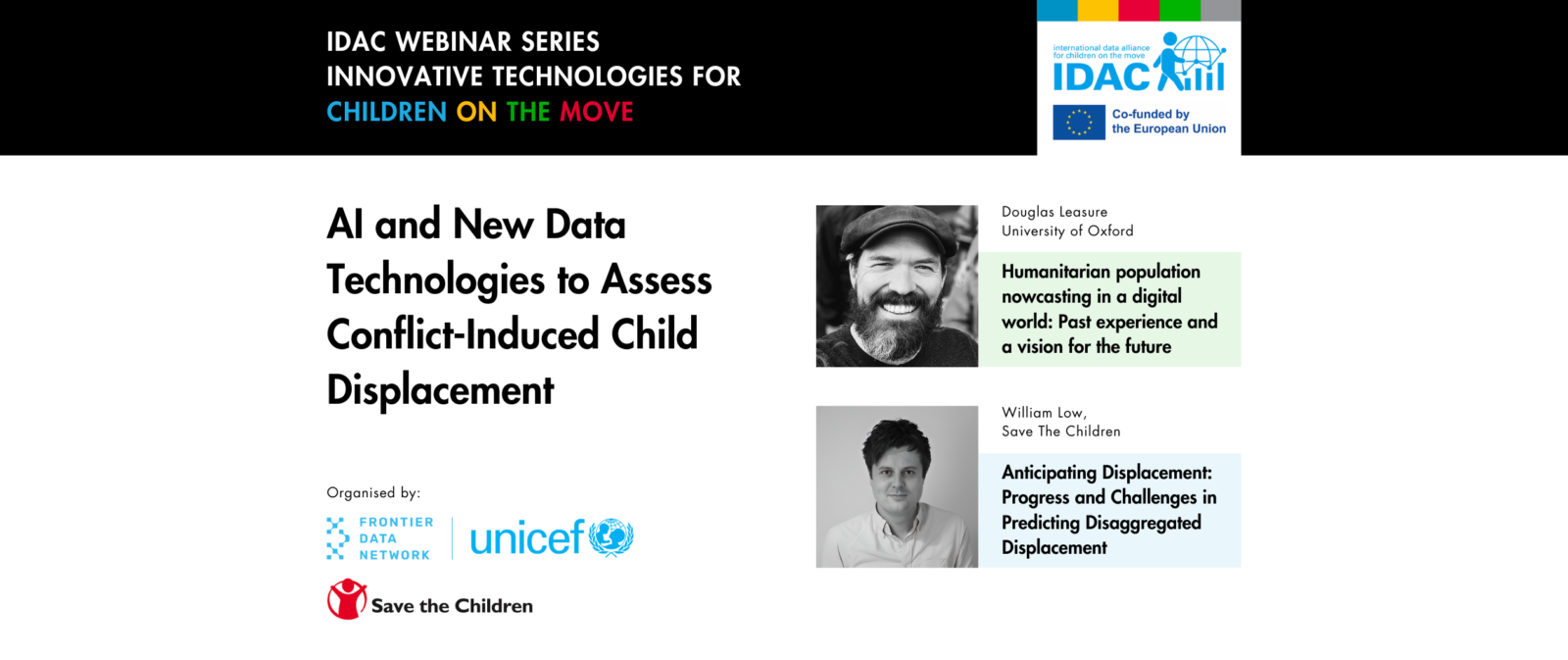
On April 3, 2025, IDAC kicked off the “Innovative Technologies for Children on the Move” webinar series with its first session “AI and New Data Technologies to Assess Conflict-Induced Child Displacement”.
Co-organised by UNICEF’s Frontier Data Network and Save the Children’s Migration & Displacement Initiative, the session explored how advanced AI and data solutions can enhance humanitarian efforts and strengthen protection mechanisms for vulnerable children in displacement contexts.
The session highlighted two pioneering approaches:
- “Humanitarian Population Nowcasting in a Digital World” by Dr. Douglas Leasure (University of Oxford) demonstrated approaches for rapidly tracking displaced populations in real-time through the integration of multiple data sources, illustrated by practical experiences in Ukraine and Gaza.
- Referenced research: “Nowcasting Daily Population Displacement in Ukraine through Social Media Advertising Data” (Population and Development Review, 2023)
- “Anticipating Displacement: Progress and Challenges in Predicting Disaggregated Displacement” by William Low (Save the Children) explored recent advances in forecasting displacement patterns and highlighted the challenges in accurately identifying and tracking children within broader migration flows.
Key insights from the webinar included the difficulty in tracking child displacement. As Dr. Douglas Leasure explained, “Children leave fewer digital traces behind. And this is one of the challenges that we’re trying to think about and work together to find answers because some of the advancements we’re making with adult populations are a bit more difficult to use for quantifying child populations.”
William Low discussed his predictive displacement approach at Save the Children, which employs predictive analytics and data science–techniques common in other fields but relatively novel in humanitarian efforts–to predict population movements caused by violent events. This strategy aids in estimating the number of people likely to be displaced, particularly children and vulnerable groups, and crucially, in identifying their potential destinations. “Right now, we do need to be working out how to do more with less.”, William Low emphasised, pointing out that enhanced predictive capabilities are essential for humanitarian organisations facing growing needs with limited resources.
Key takeaways from the webinar included:
- Data triangulation is critical: All data streams can become unstable in conflict zones, making it essential to combine multiple sources for more accurate population estimates
- Digital invisibility of children: Special methods are needed as children generate significantly fewer digital traces than adults
- Complex family structures: Displacement involving children travelling with extended family or community members requires nuanced demographic analysis
- Preparation before crisis: Successful implementation requires developing methodologies before emergencies occur
- Data integration across sources: The future lies in combining various data types rather than relying on single innovative sources
Both presenters highlighted that the future of this work depends on strong partnerships between academic and humanitarian organisations. “What we, I think, need to do is develop the methods together before the crisis so that we have this kind of framework ready when the crisis comes“, noted Dr. Douglas Leasure.
This webinar marked the beginning of IDAC’s series exploring how new technologies can address pressing issues affecting displaced children worldwide.
We welcome your suggestions for future topics, speakers, or contributions to this series as we continue exploring innovative data approaches to support children on the move. Please contact us at [email protected] with your ideas or to share your work in this area.
For more information and upcoming webinars, visit www.dataforchildrenonthemove.org, subscribe to our newsletter or follow IDAC on LinkedIn.
Watch the webinar recording:
