

Collaboration. Partnership. Visibility. Protection. Evidence. Action. Children.
These were just some of the words IDAC members used when asked to describe what the alliance means to them during the 2026 IDAC All Member Meeting.
Those themes shaped the discussion in early July, which brought 55 representatives from governments, UN agencies, NGOs, academia and youth organizations together to answer a defining question: What have we achieved so far – and how can IDAC build on that impact?
Together, IDAC members took stock of progress to date, shared lessons from across countries and regions, and identified priorities for strengthening data systems, fostering innovation and supporting countries to generate the evidence needed to improve the lives of children on the move.
Opening the meeting, Lisa Celebi, Policy Officer and Programme Manager for Forced Displacement at the European Commission’s Directorate-General for International Partnerships (DG INTPA), emphasized the importance of partnership in turning better data into better outcomes for children on the move.
“Investing in data is not only about better analysis,” she said. “It’s also about better inclusion in national systems, public policy and social and economic opportunities. Partnership is key – and IDAC plays an important role in bringing these efforts together.”
IDAC: Milestones and momentum
🌍 23+ countries and partners supported through technical initiatives
👥 1,600+ participants engaged through webinars, workshops and global meetings
📄 13 technical publications and knowledge products released
🤝 14 countries engaged through regional capacity-strengthening workshops
🧠 94% surveyed IDAC members reporting that membership or affiliation with IDAC improved technical knowledge
🏢86% reporting enhanced institutional capacity to produce sex- and age- disaggregated data
In a joint presentation, members from IDAC’s Secretariat described the impressive gains made across IDAC’s three workstreams.
Pillar 1: Strengthening national data systems and capacities
IDAC expanded support to countries by translating global guidance into practical implementation and technical assistance.
- Produced guidelines and tools, including the first child-specific indicators for children on the move and new resources to support harmonized data collection, analysis and communication.
- Launched regional technical workstream, equipping 14 countries (and counting) with the skills to assess data systems and implement IDAC indicators through peer exchange.
- Expanded country support through capacity-strengthening pilots in Indonesia, Kenya and Nigeria.
Pillar 2: Promoting and establishing collaboration and innovation
IDAC brought together experts from across sectors to explore new ways of closing persistent data gaps affecting children on the move.
- Launched the Innovation Webinar Series, showcasing emerging approaches including AI, geospatial methods and innovative data sources.
- Produced a compendium on innovative approaches, synthesizing the latest evidence to guide responsible use of new methodologies (expected release in August/September).
- Advanced collaborative approaches, including MMC-led publication on Afghan children in Pakistan and the UNHCR-OECD Datathon, to test innovative approaches in practice.
Pillar 3: Improving data visibility, availability, accessibility and usability
IDAC continued to sound the call for better data around the globe, advocating for action on behalf of the world’s most marginalized children.
- Raised the visibility of children on the move through 18 high-level events, conferences and global forums.
- Published 13 technical resources, helping strengthen the evidence base for policy and programming.
- Expanded digital access to data through the launch of the interactive Key Facts platform and development of the IDAC Data Gateway.
Survey results and regional workshop feedback show that members find IDAC’s work highly relevant – and that demand is growing, with participants eager for further support in key technical areas, including the implementation of IDAC indicators.
Young voices shaping the agenda
Youth participation remained central to IDAC’s work. Yashiba Sanil, Policy and Operations Manager at IDAC partner the Migration Youth and Children’s Platform (MYCP), reflected on the growing impact of the Youth Committee on Migration and Displacement Data (YCMDD) – a joint IDAC-MYCP initiative.
“Data innovation is not simply about producing better datasets,” she said. “It’s just as important to make sure that research recognizes children and young people as rights holders, as knowledge producers and as stakeholders in systems that govern their lives.”
From data to action
The meeting also highlighted how IDAC’s work is increasingly translating into national and regional action. In Djibouti, the country’s Plan for the Development of Human Capital now incorporates key indicators on children on the move. Meanwhile, STATAFRIC – co-host of IDAC’s recent regional workshop in Nairobi – announced that the next Strategy for the Harmonization of Statistics in Africa (SHaSA 3) will establish a dedicated Working Group on migration statistics, with IDAC serving as a key partner.
These examples illustrate how IDAC is translating evidence into action. But they also raised an important question for members: How can the partnership build on these successes, deepen its support to countries and accelerate progress in an increasingly challenging global environment?
IDAC 2.0: Building on our strong foundation
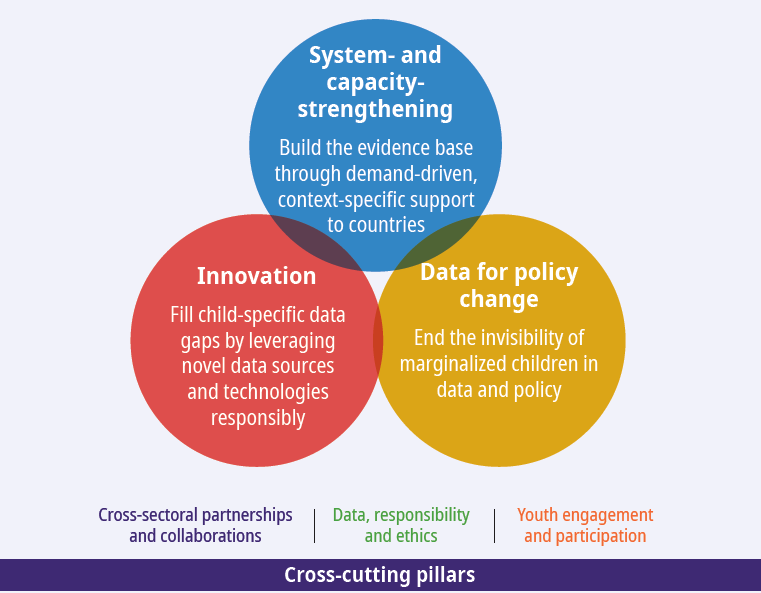
Danzhen You, UNICEF Chief of Demographics and founder of IDAC, outlined a vision for the alliance’s next phase. While acknowledging that deep data gaps persist amid escalating global crises and funding constraints, she emphasized that IDAC’s mission is more critical than ever.
“IDAC has made an impressive mark at the global level,” she said. “Looking ahead, the IDAC Secretariat would like to move further toward implementation and action, building on the critical guidelines, tools, networks and partnerships we have developed globally.”
Building on the progress achieved to date, IDAC envisions a future focused on demand-driven country support, stronger regional implementation, greater links between evidence and action, responsible innovation and deepening partnerships – helping ensure that child-sensitive data lead to meaningful improvements in the lives of children on the move.
Tune in this fall, when IDAC members will reconvene for an interactive session to further refine the partnership’s priorities and help shape the next phase of IDAC’s work together.
Watch the All Member Meeting:
