
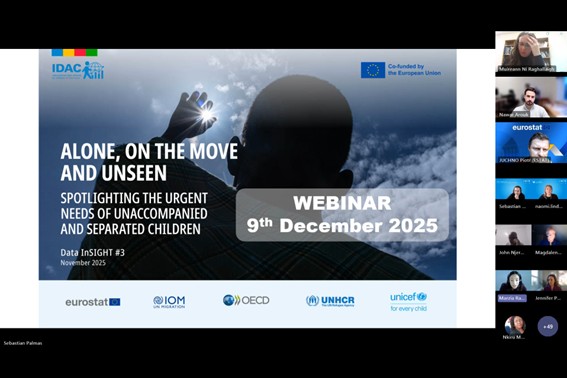
Over the past decade, the growing number of children traveling alone or becoming separated from their families has raised alarm among humanitarian and child protection actors. While some progress has been made to protect these children and reunite them with their families, unaccompanied and separated children still face serious violations of their rights – and remain largely missing from official statistics, policies and programming.
A new IDAC report, Alone, On the Move and Unseen: Spotlighting the urgent needs of unaccompanied and separated children, takes a close at this group of children – highlighting what the current evidence indicates about their situation – and emphasizes the urgent need for better data to support and empower them.
To discuss the report’s findings and the critical role of data and statistics in protecting children on the move without a parent or caregiver, IDAC convened a panel of cross-sectoral experts in December that brought together statisticians, child protection and migration specialists, NGOs and youth.
Scroll down or click here to watch the webinar.
Limited data, serious risks
UNICEF Data Specialist Sebastian Palmas, co-author of the report, opened the session by highlighting a worrying trend: “Across many migration routes, we see that a worrying number of children are on the move without a parent or caregiver,” he said. “But many of them are not captured in data and evidence and the scale of their movement is almost certainly larger than what the data reveal.”
These children face severe risks, including food insecurity, limited access to health care, exposure to violence and exploitation, and interrupted education.
To better understand the scope of these rights violations – and to inform effective policies and programmes –data systems must be strengthened. This includes adopting standardized definitions, using responsive methodologies that fill gaps left by household surveys, making concerted efforts to build trust with children on the move, responsibly leveraging diverse data sources and innovative tools for real-time monitoring of unaccompanied and separated children, and improving collaboration and data-sharing agreements.
A need for transparency and harmonization
Nawar Arouk, who travelled unaccompanied as an adolescent refugee from Syria, highlighted the intrinsic need for transparency and trust when collecting data on children. “Every data set begins with a conversation with a child who must feel safe enough to speak or even identify themselves,” he said.
Eurostat’s Piotr Juchno shared the EU experience, where policymakers recognized that actions to protect unaccompanied and separated children demanded parallel improvements and investments in statistics – including the collection of disaggregated data by age, sex and migratory status. Though statistical knowledge in the region is now relatively strong, Juchno stressed, there are still issues to resolve.
“Data gaps still exist at the national level – often linked to administrative systems,” he said. “And while certain policy areas in the EU are well harmonized by law, this is not the case with migration policy – which has led to varying administrative practices that hinder data comparability.”
Data for good
Laurent Chapuis, who leads UNICEF’s case management work on unaccompanied and separated children, captured the humanitarian community’s longstanding recognition that children on their own in displacement contexts face distinct and severe risks – risks that must be understood through quality evidence in order to effectively respond to them. Data are central to these efforts, he explained. “They help shape the response and contribute to system-strengthening – not only in terms of data systems, but also of broader child protection and asylum systems. We also know how powerful data are when it comes to raising resources and advocating for adequate policy and legal reform.”
The 60-minute session closed with remarks by Jennifer Podkul of NGO Kids in Need of Defense (KIND), who reminded the audience of the need to ensure data work for, not against, children. “Doing a better job of collecting disaggregated data on unaccompanied and separated children is not an end in itself,” she said. “What’s important is that the data collection is undertaken with the purpose and intent of ensuring the safety and well-being of children.”
