
Disasters were linked to 14.5 million new internal displacements of children in 2024 – many driven by the impacts of climate change. Yet despite these growing risks, children affected by climate-related mobility remain largely invisible in humanitarian response systems.
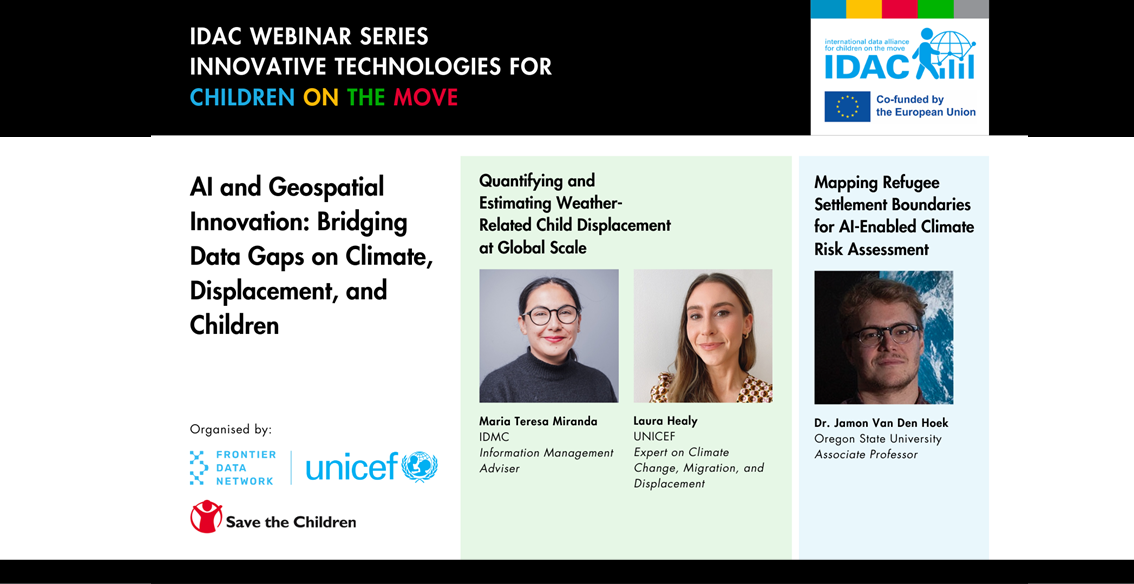
IDAC’s Innovation Working Group convened experts to explore how AI and advanced geospatial technologies are closing critical data gaps at two crucial intersections: climate as a driver of child displacement, and the heightened climate risks facing displaced populations.
Scroll down or click here to watch the full webinar recording.
Internal displacement: The current situation and what’s to come
“We simply don’t see children in the data,” said UNICEF’s Laura Healy, Climate Change, Protection and Migration Specialist. “That means we can’t target services and resources or prioritize the most at risk in efforts to prepare, plan and respond.” Only 2.4 per cent of global climate finance supports child-specific solutions, Healy noted.
Maria Teresa Miranda Espinosa, Information Management Adviser at the Internal Displacement Monitoring Centre (IDMC), underscored the urgent need for disaggregated data on disasters. “There’s a basic lack of baseline data because disasters are highly under-reported,” she said, highlighting that IDMC’s already concerning estimates are undercounts.
To improve children’s visibility in the data, UNICEF and IDMC developed a ground-breaking methodology to estimate weather-related child displacements. Leveraging IDMC’s multi-hazard risk model, which uses historical data and climate scenarios, the analysis found that between 2016 and 2023, an estimated 62 million internal displacements of children occurred – mostly due to floods and storms. The model also offered a sobering look ahead: Over the next 30 years, an estimated 114 million child displacements could occur – 96 million of them linked to riverine flooding.
These findings are now being used to help countries’ identify high-risk areas with low coping capacity, inform inclusive early warning systems, support pre-emptive evacuation planning, and prepare education, health, and child protection systems to be climate-resilient and ready to absorb displaced populations.
While these efforts are improving the evidence base, further investments in data collection, analysis, use and continued innovation must become national priorities to ensure that displaced children are clearly visible in data and decision-making.
Mapping refugee settlements to assess climate risk
Meanwhile, at Oregon State University, Associate Professor Dr. Jamon Van Den Hoek and his team at the Conflict Ecology Lab are developing a global, fully attributed dataset of settlement boundaries to better assess climate-related risks among refugee populations. “Right now, when we think about the potential impacts of climate change in over 1,500 global refugee camps, we’re quite hobbled from a geographer’s perspective,” he explained, noting the lack of precise geospatial data on these areas.
Slated for released in spring 2026, the open database aims to create analysis-ready boundaries enriched with environmental, climatic, and socioeconomic data – measuring everything from hazard exposure to proximity to critical infrastructure like schools and clinics. “With these very large camps, when we have really large settlements, the differences in flood risk potential, the differences in slope, the differences in access – all of these vary,” Van Den Hoek noted. “Is that variation important? Yes, especially when we have really, really large settlements.”
Dr. Van Den Hoek issued a direct call to action for the humanitarian and research communities: “We really do want to know if we’ve made a mistake and where these boundaries are. We really do want to know what variables to track,” he emphasized.
To help guide which satellite image-derived variables and geospatial datasets are included in the open database, or to get involved, contact the team here.
Pressing issues and the path forward
The discussion highlighted several persistent challenges that require continued attention:
- Data quality: Understanding how data were collected, their limitations and potential biases is critical.
- Coping capacity: Risk models must identify where risk is high and coping capacity low.
- Temporal and geographic granularity: Subnational, disaggregated data are key to preparedness and focused interventions.
- New technologies: Translating innovations into systematic, scalable solutions that provide a comprehensive global picture of displacement is still a major hurdle.
To ensure children are not left behind in the climate agenda, the global community must strengthen data systems and invest in evidence generation to better track and monitor children on the move, while also ensuring disaggregation by age, sex and displacement status. Existing data can also be put to better use, particularly within climate planning where displacement data are often absent. At the same time, fostering collaboration across experts and local actors is key to fortifying and protecting the data ecosystem itself.
“This is not just another vulnerable group,” Healy underscored. “Meeting their needs is actually a strategy to build more resilient families, more resilient communities, and stronger economies overall.”
This second instalment in IDAC’s “Innovative Technologies for Children on the Move” webinar series emphasized the critical need for AI and advanced analytics to be grounded in high-quality, transparent and context-specific data. The goal is not more data, but the right data – properly attributed, well-scaled and fit for fit for the life-saving decisions that depend on it.
This webinar was organized by IDAC’s Innovation Working Group, co-led by Save the Children and UNICEF, with support from UNICEF’s Frontier Data Network.
