
Children on the move are often statistically invisible – their numbers inferred from assumptions about adults or households rather than child-specific evidence.
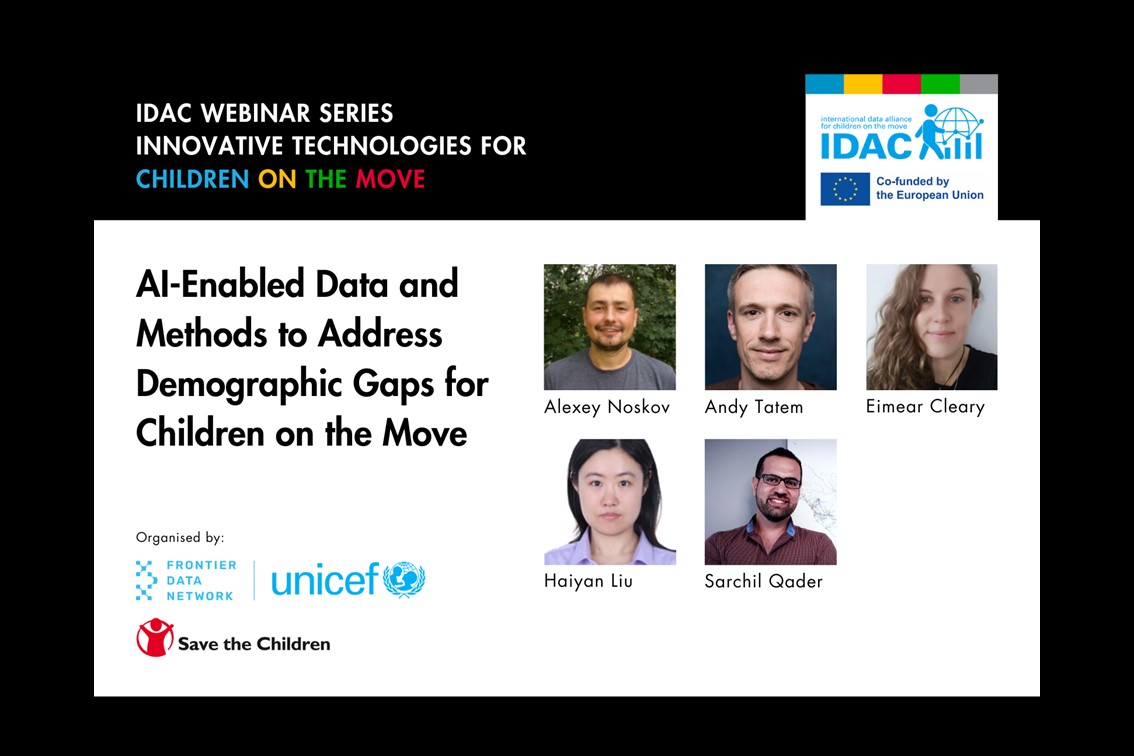
In IDAC’s latest Innovation Webinar, WorldPop, a leading population research group based at the University of Southampton, brought its expertise to this pressing issue, examining where the science stands: what is genuinely possible, where it falls short and what a path forward looks like.
Scroll down or click here to watch the full webinar recording.
An expanding toolkit
Population modellers can now disaggregate census data to estimate where people live at a 100-metre resolution, as WorldPop’s Dr. Andy Tatem explained. By stacking different layers of information – e.g., satellite-derived building data, infrastructure layers and night-time lights imagery – researchers are now able to estimate where people, including children, live at fine geographic scales. These methods are already being used to plan vaccination campaigns, design census enumeration areas and estimate the number of children exposed to flooding or conflict in a given area.
Novel digital data sources offer a complementary window into real-time mobility. Call data records from telecom operators, Meta’s movement distribution data and newer sources like Google’s aggregated search and Points of Interest embeddings all provide signals about where populations are moving – at a speed and scale traditional surveys cannot match. Research from China demonstrates how these data can have real impact: Using mobile phone data covering over 77 per cent of the national population, a multi-hazard early warning system was able to send targeted alerts that reduced disaster exposure by 57 per cent and cut post-disaster recovery time significantly.
On displacement, AI and machine learning are enabling meaningful improvements over conventional reporting. A WorldPop-UNHCR proof-of-concept in Cameroon combined machine learning applied outside refugee camps with simpler disaggregation methods within them, enabling fine-scale spatial estimates where populations had previously been represented as single geographic points. This output directly informed Cameroon’s 2024 displacement survey, where WorldPop tools generated a customized national sampling frame representative of forced displacement populations for the first time.
Limitations and challenges
For all this progress, the message from WorldPop is clear: children, in particular, remain difficult to see – and challenges grow as questions get more specific. While national or regional population estimates are increasingly reliable, child-specific estimates at the ward or settlement level – particularly for mobile or displaced children – carry substantially higher uncertainty.
The core problem with digital data is that children are largely absent from them. Mobile phones, social media accounts and app-based platforms are adult-dominated – young children leave almost no digital trace. This leaves researchers to infer child behaviour from adult proxies – assuming, for example, that children move with caregivers and that adult mobility patterns reflect their own. While intuitive, this assumption is empirically unverified. Research suggests mobile phone data may significantly overestimate child mobility compared to actual travel survey data. As Dr. Haiyan Liu noted during the webinar, children under 6 are largely absent from mobility data.
Displacement data introduce their own complications: fragmented sources, inconsistent definitions, mismatched administrative boundaries and significant variation in registration data quality across countries. Even where child-disaggregated data exist within displacement databases, extracting them systematically requires additional investment that is rarely available. Meanwhile, the traditional foundations that underpin all population modelling – censuses and household surveys – are under threat from declining funding and political appetite.
What success could look like
Speakers converged on a vision that is less about technological breakthrough and more about structural change in how data ecosystems work. The single most consistent theme was co-development: Population modellers, child-focused practitioners, government statisticians and data collectors need to be in the room from the start of any project as a methodological necessity. The difference between outputs that inform decisions and outputs that sit unused is almost always whether the right people – including end users – have shaped them. As Tatem explained:
“If we want to see any of these new types of data actually be used, there is really a need to have trust built up – and that means engaging from start to finish with those who are actually going to use the data.”
On the technical side, two near-term improvements would make a disproportionate difference:
1) Interoperability: Displacement and population datasets are currently collected in different formats, structures and definitions that make integration difficult even when the underlying data are rich. Making data interoperable – and geo-referenced by default – would dramatically expand what is analytically possible.
2) Better calibration of digital data against ground truth: Conducting even small travel surveys that ask about mobile phone ownership and app use alongside actual mobility patterns could help characterize biases in digital sources in different contexts. This would allow for more principled corrections and a more accurate picture of children’s mobility.
Looking further ahead, success means a world in which child populations in displacement are not a residual calculation – derived from adult estimates with age-structure assumptions applied after the fact – but a first-order input into data systems. That requires investment in the household surveys and civil registration systems that provide the demographic ground truth everything else depends on – and making the political case for data as public infrastructure that needs to be protected. it.
This webinar took place on 29 February 2026. The ‘Innovative Technologies for Children on the Move’ series is organized by IDAC’s Innovation Working Group, co-led by Save the Children and UNICEF, with support from UNICEF’s Frontier Data Network.
Access prior webinars to examine the role of innovation in:
